
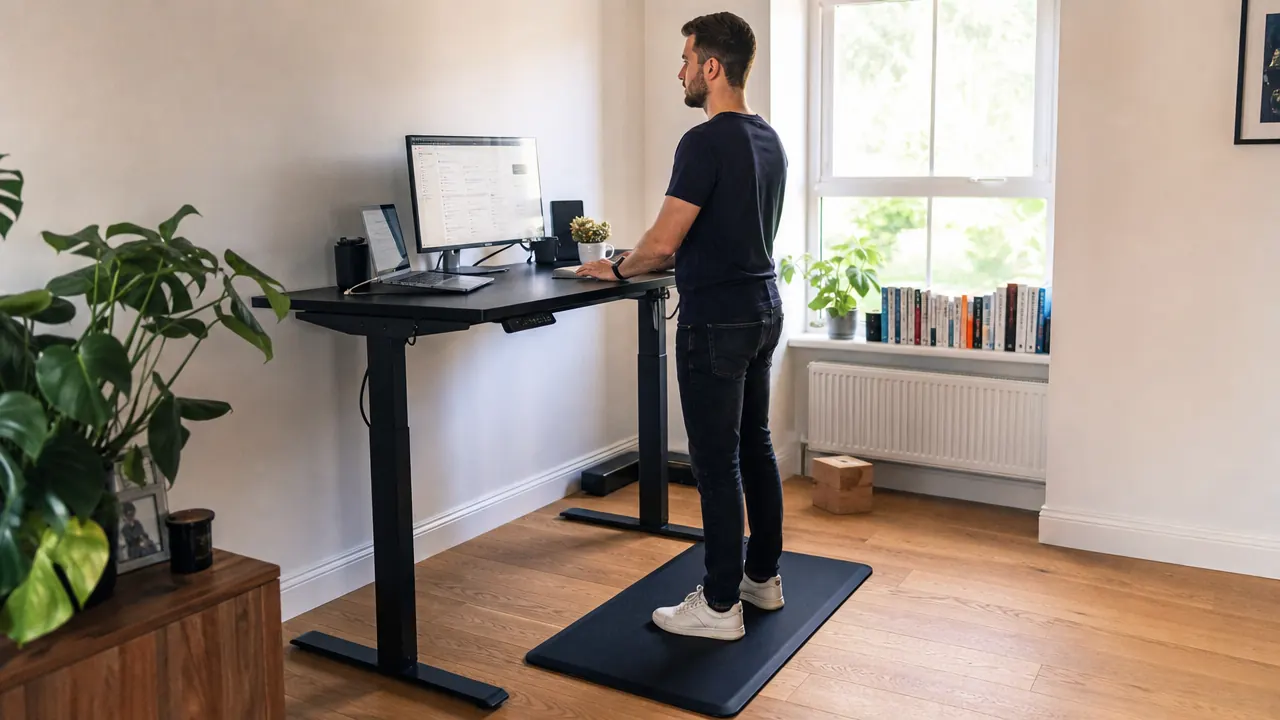
My feet were wrecked. Six months into working from home with a standing desk, I was standing three to five hours a day and by 2pm my heels ached and my calves felt like I had been hiking in bad shoes. I tried thick wool socks. I tried taking sitting breaks more often. I tried putting a folded yoga mat under my feet for a week, which worked until it bunched up and became a tripping hazard. None of it fixed the core problem. The floor is hard, and your feet are not designed to stand still on hard surfaces for hours at a time.
I finally bought the ComfiLife Anti-Fatigue Mat in the 3/4 inch thickness, 20 x 39 inch size. That was just over a year ago. I have stood on it almost every workday since, roughly 200 to 250 standing hours total. This review is what I actually experienced, including the parts the product listing does not mention.
The Quick Verdict
Genuinely effective cushioning that holds up after a year of daily use. Not the plushest mat you can buy, but well-built, affordable, and noticeably better than standing on hardwood.
Amazon Check Today's Price →Your feet should not hurt by 2pm. The ComfiLife mat is the simplest fix on the market.
Over 40,000 Amazon buyers have rated it 4.8 stars. It is 3/4 inch thick, non-slip on hardwood or tile, and currently available at its regular price.
Amazon Check Today's Price on Amazon →How I Have Used It
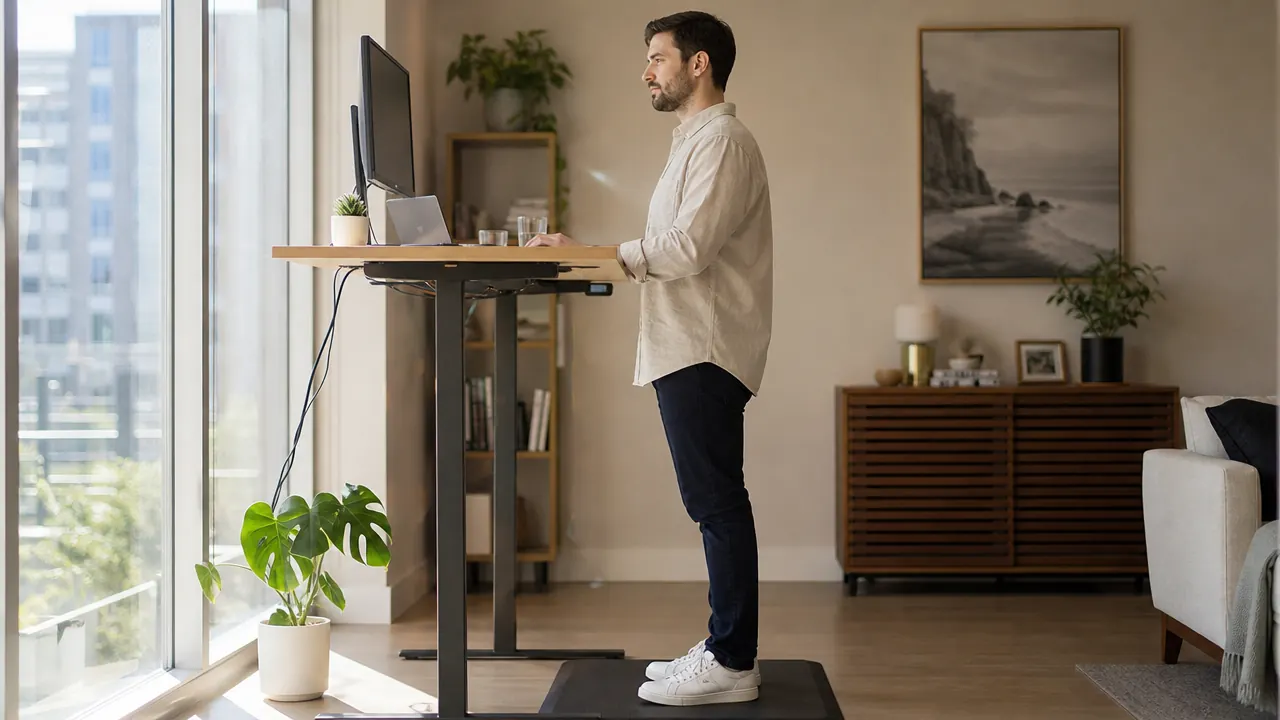
My setup is an electric standing desk in a spare bedroom, hardwood floors, and a MacBook connected to a monitor. I am 5 feet 11 inches, 175 pounds, and I wear New Balance sneakers or wool socks while standing. I work remotely full-time, writing and doing video calls, so I stand for 2 to 4 hour blocks most days.
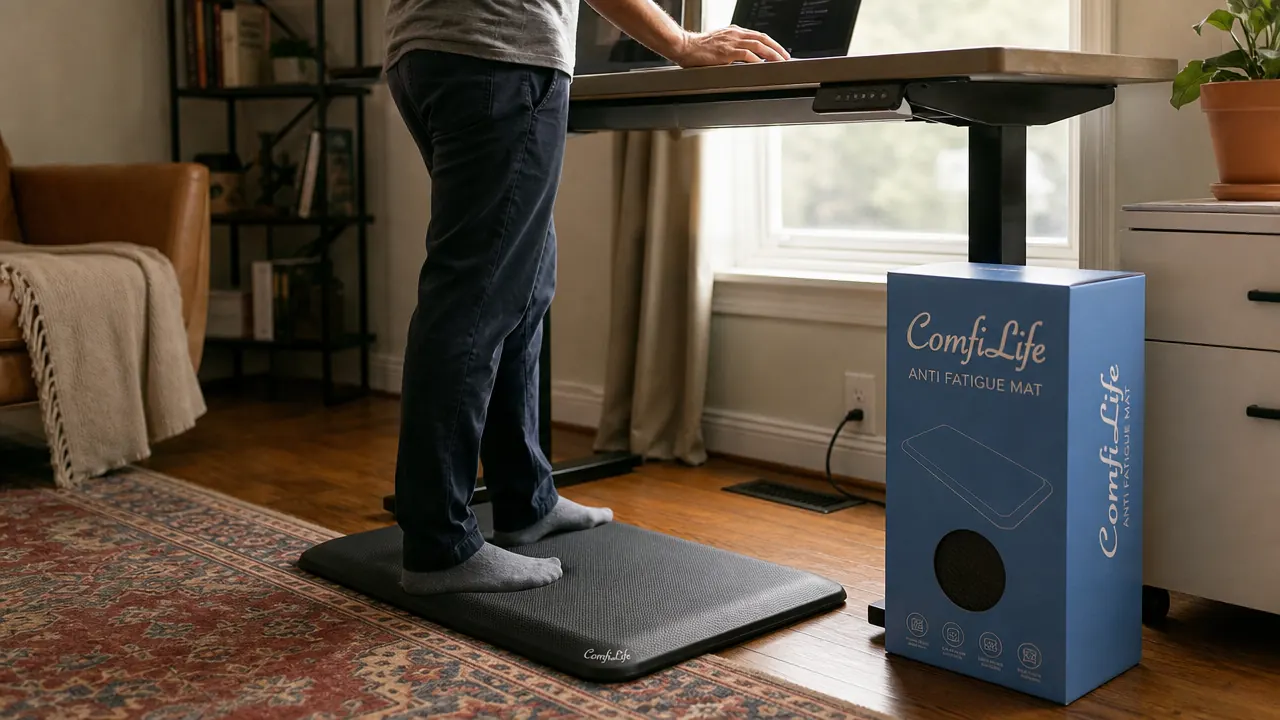
I placed the mat directly in front of the desk and have not moved it since. It stays put. The non-slip bottom has never shifted on my hardwood floors even when I step on and off quickly. No tape, no furniture grippers needed. That alone puts it ahead of the yoga mat experiment.
For the first two weeks, I was skeptical. The mat felt firm, not soft. I had expected something more like stepping onto a memory foam mattress topper. What I got was more like the floor in a good pair of running shoes: supportive and slightly giving, but not squishy. That distinction matters. Soft mats feel comfortable in the first ten minutes and cause fatigue in the first hour because your ankles are constantly micro-adjusting. The firmness here turned out to be the right call.
What the 3/4 Inch Thickness Actually Does
The main job of an anti-fatigue mat is to reduce the pressure transferred from a hard floor up through your heel, arch, and calf. A 3/4 inch foam mat does this by absorbing some of the impact and allowing your foot to flex slightly with each micro-movement, which keeps blood circulating. Standing on hardwood is like standing on concrete inside a building. You are stationary, the surface is unforgiving, and after 90 minutes your body starts demanding you move.
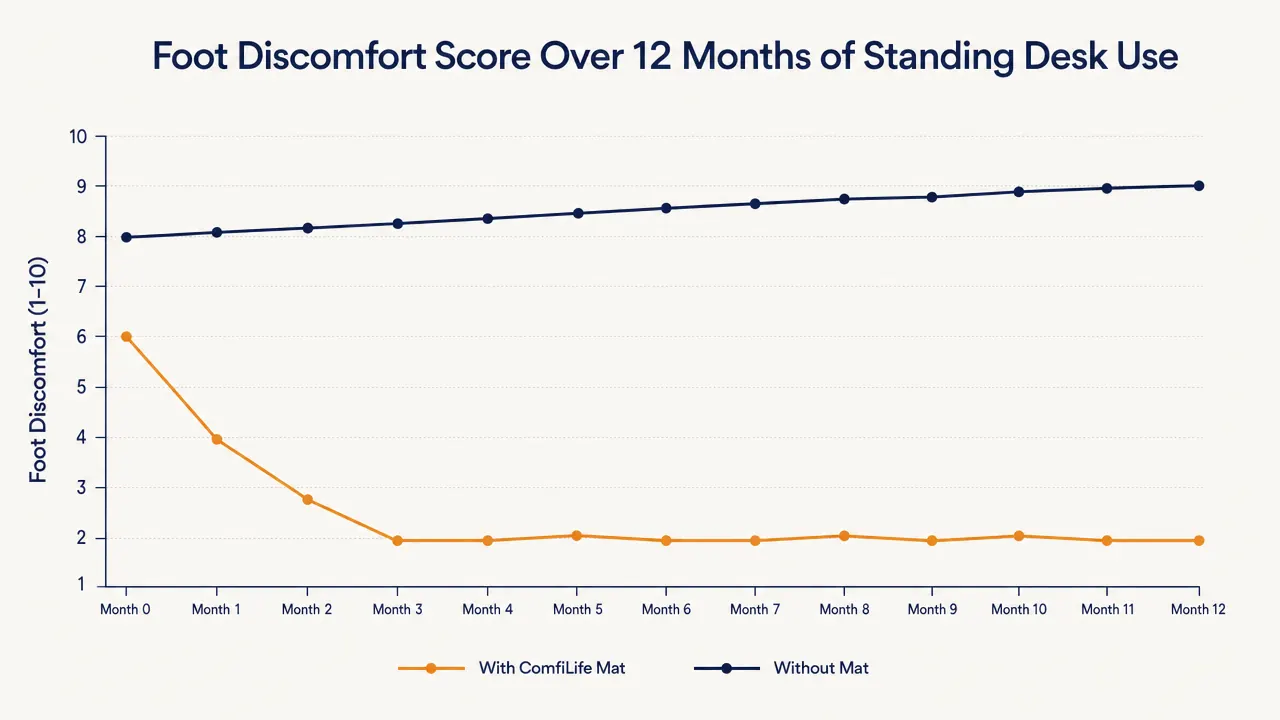
The ComfiLife mat noticeably extended how long I could stand before that demand hit. Where I used to hit a wall at 60 to 90 minutes on bare floor, I was consistently standing 90 to 120 minutes before needing to sit. Not life-changing, but real. Over a 6 to 8 hour workday that compounds: one extra half-hour of standing time per block adds up to significantly more movement and less sitting by Friday.
The 3/4 inch option was the right call over the 1/2 inch. I did not try the 1 inch, but reviews suggest it can feel too soft for people who are on their feet all day rather than standing periodically.
Where I used to hit a wall at 60 to 90 minutes standing on bare floor, I was consistently pushing 90 to 120 minutes on the ComfiLife mat before needing to sit.
Durability After One Year of Daily Use
This is the part most reviews skip because they are written after two weeks. After 12 months of daily use, here is the honest state of my mat.
The foam has compressed slightly in my primary standing zone, which is the center of the mat directly in front of the keyboard. If I place a straightedge across the mat, I can measure about 1/16 of an inch of compression in that zone compared to the edges. In practical terms, I cannot feel the difference. The mat still feels supportive and cushioned. It does not feel worn out.
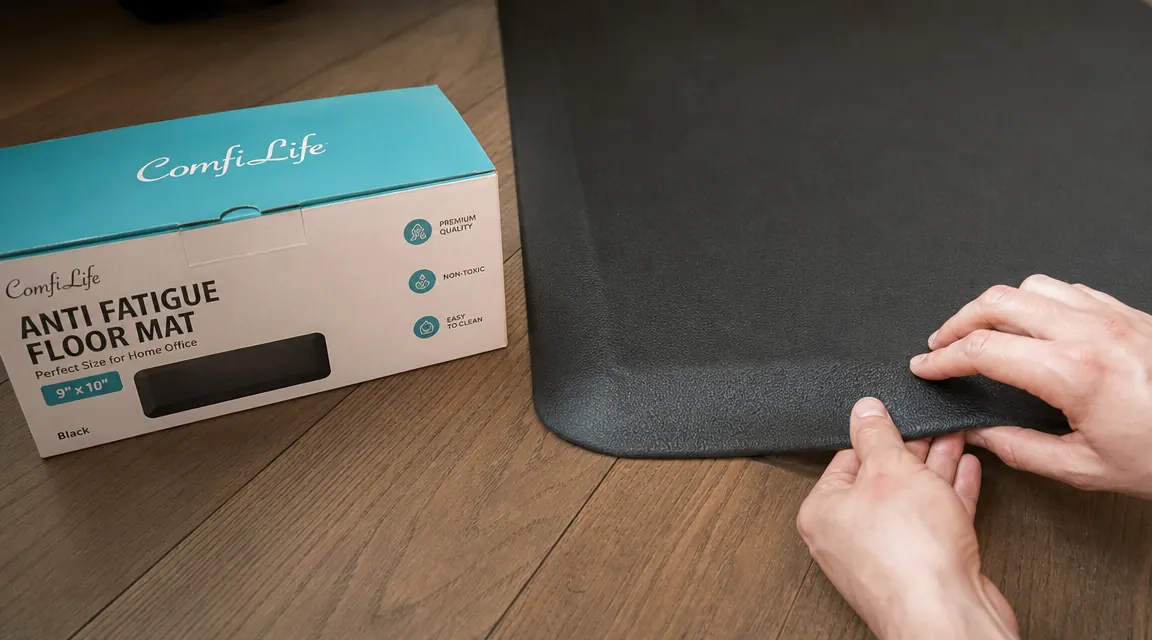
The beveled edges, which exist to prevent tripping when you step on and off, are the area I watched most closely. After 12 months, they have held their shape on three of four sides. The fourth edge, the one I always step over when sitting down, shows minor flattening but has not cracked or curled. That surprised me. I expected the edges to peel up or roll inward the way cheap foam mats do. They have not.
The surface texture is unchanged. It felt slightly grainy when new, probably to prevent socks from sliding, and it still feels the same. No pilling, no surface cracking, no visible foam degradation.
The Smell Issue and How It Resolved
Out of the box, this mat smells. It is a chemical foam odor, not overwhelming, but distinctly present. I noticed it for about the first four days. By day six, it had faded to almost nothing. By week two, it was gone entirely.
If you are sensitive to off-gassing smells or if the mat will be in a small room without good airflow, unbox it a couple of days before you plan to use it and let it air out flat. Running an air purifier in the room speeds this up. This is a known issue with any dense foam product and it is not specific to ComfiLife, but it is worth knowing before you put it down and immediately stand on it for four hours.
Cleaning: Easier Than I Expected
I wipe the surface down about once a week with a damp cloth. I have also cleaned it twice with a diluted all-purpose cleaner after spilling coffee nearby. Both times it dried in about 15 minutes and showed no staining or surface damage.
The non-slip rubber underside picks up hair and dust because it grips surfaces well. I flip it over every few weeks and vacuum or wipe the bottom. Not a big deal. If you have pets that shed, just know you will be cleaning the underside more often.
Where It Falls Short
The mat is rectangular and flat. It works well for standing in one position, but it does not encourage movement the way terrain-style mats do. Products like the Topo by Ergodriven have raised contours that prompt your feet to shift around, which some ergonomists say is better for circulation. If you want to actively move your feet rather than just stand with better cushioning, a terrain mat is worth considering. My full comparison of the ComfiLife against the Topo is available here: ComfiLife vs Topo by Ergodriven.
The 20 x 39 inch size fits my stance well but leaves no room to step back while still on the mat. If you shift your weight a lot or walk in place while thinking, you may want the larger 24 x 70 inch version. I would have bought that size if I had it to do again.
There is also no carrying handle or storage roll feature. It is a flat mat. If you regularly pull the mat out and put it away, the size makes that slightly awkward. For permanent placement, which is how I use it, that is not an issue.
What I Liked
- Noticeably extends comfortable standing time, 90 to 120 minutes versus 60 to 90 on bare floor
- Beveled edges have held their shape after 12 months of daily use
- Non-slip bottom stays in place on hardwood and tile with no accessories needed
- Surface texture unchanged after a year, no pilling or cracking
- Cleans up easily with a damp cloth or mild cleaner
- At current pricing, among the best value anti-fatigue mats available
Where It Falls Short
- Foam off-gassing smell for the first 4 to 6 days after unboxing
- Flat surface does not encourage active foot movement the way terrain-style mats do
- Standard size (20 x 39 inches) is narrow for users who shift stance or pace
- Slight compression in the primary standing zone after 12 months, though not noticeable underfoot
How It Compares to the Alternatives I Considered
Before buying, I looked at three options. The Topo by Ergodriven costs significantly more and is designed around active micro-movement. The Gorilla Grip mat is cheaper and thinner at about 1/2 inch. And the Sky Solutions commercial-grade mat is used in kitchens and factories and runs about the same price.
I chose the ComfiLife because it sat in the middle on every axis: thickness, price, reviews, and build quality. After a year, I would make the same choice for a home office situation. The Topo is better if micro-movement and posture variety are your priority. If budget is tight, the Gorilla Grip is a reasonable option. For most remote workers who just want to stand longer without their feet hurting, the ComfiLife hits the target.
If foot pain at a standing desk has been an ongoing issue for you beyond just the mat, there is more you can do. Good footwear, standing intervals, and posture changes all compound with a mat. This guide goes deeper on all of it: How to Reduce Foot Pain at a Standing Desk.
Who This Is For
The ComfiLife mat is the right buy if you have a standing desk and are standing on hardwood, tile, or concrete floors. It works best for people who stand in blocks of 60 to 150 minutes and want reliable cushioning without spending more than necessary. If you have mild plantar fasciitis or heel pain that gets worse after standing, this mat will help, though it is not a substitute for orthotics if the issue is medical.
It is also a solid buy if you are still building up your standing tolerance. New standing desk users often give up on standing because the discomfort is too much too soon. Having a good mat from day one makes the adaptation much smoother. I cover the full standing desk setup, including mat placement and height settings, in this guide: How to Set Up a Home Office Standing Desk the Right Way.
Who Should Skip It
If you stand at a kitchen counter or on carpet, you probably do not need this. Carpet already provides some cushioning and grip, and the non-slip bottom is largely redundant on soft surfaces. If you want active foot engagement rather than passive cushioning, look at the Topo by Ergodriven instead. And if you are standing fewer than 30 minutes per day, the mat will make minimal difference. Save the money and invest it elsewhere in your setup.
If you have an existing back or joint condition that is worsening from standing, a mat is a small part of the solution. The bigger factors are desk height, monitor position, and how long you stand in one stretch. Check the ergonomics guide linked above before expecting a mat to solve a larger setup problem.
A year in, I would buy the ComfiLife mat again without hesitating.
It is still supportive, still flat, still non-slip. For under fifty dollars it is one of the few standing desk accessories that earns its spot every single day. Check the current price on Amazon below.
Amazon Check Today's Price on Amazon →